Writing archive in progress.
My posts and articles published on other platforms will appear here with links.
AI can't substitute a junior consultant
URL: https://www.linkedin.com/feed/update/urn:li:activity:7417853143708753920/
Date: 2026-01-16
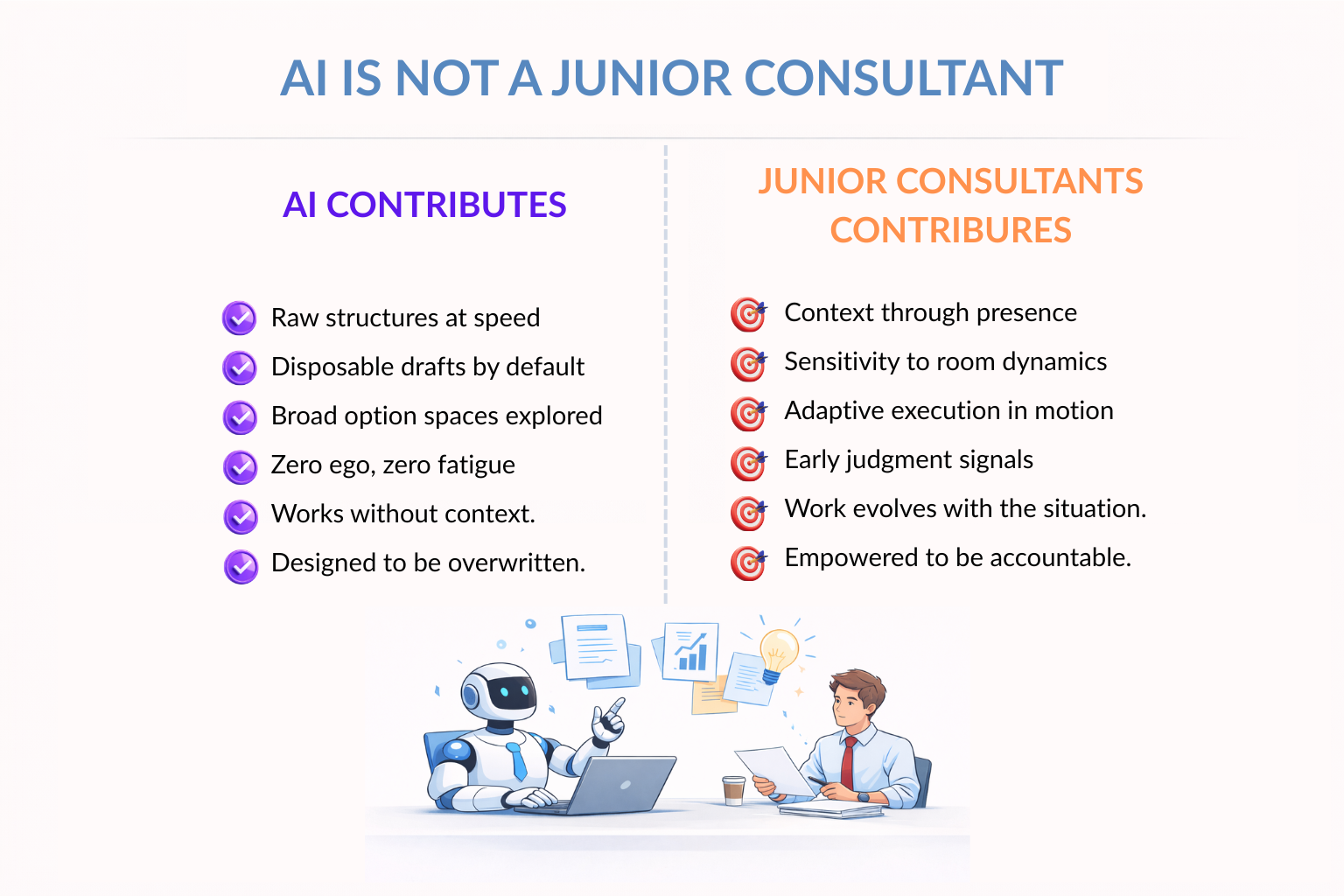
AI is not a junior consultant.
It’s a first-pass machine.
That distinction matters more than most clients realise.
A junior consultant isn’t valuable just because they produce slides or analyses. Even early in their career, they pick up on hesitation in a room. They sense when a “logically correct” option will never land. They adjust their work based on how people react, not just what the framework says.
That’s not output.
That’s human presence in context.
AI brings none of that.
What it does bring is something very different. It works fast, without ego. It explores broadly, without preference. It generates rough structures and messy drafts without getting tired or attached to them.
It will happily go down paths you already suspect are wrong, which is exactly why it’s useful at the very start.
AI doesn’t replace a junior consultant. It replaces the fiction that someone had the time to properly explore the problem space before narrowing it down.
That’s the real division of labour.
AI gives you raw material. Consultants decide what deserves oxygen.
AI can generate structures, outlines, and alternative framings. Consultants provide judgment, narrative restraint, and the ability to build commitment around a chosen direction.
A simple rule holds surprisingly well in practice.
If the work is something you expect to rewrite, are comfortable deleting, and wouldn’t attribute to a person, AI is a good fit.
If it’s something you’d stand behind in a client conversation, that’s still firmly human territory.
Next post, I’ll break down what actually makes a good first pass in consulting, and why most prompts fail to produce one.
Using AI without client's sensitive informations
URL: https://www.linkedin.com/feed/update/urn:li:activity:7415340313252466689/
Date: 2026-01-09
Most AI advice in consulting ignores one inconvenient truth:
👉 We’re not allowed to use the most critical and sensitive client information in these tools. 👈
This isn’t a technical limitation. It’s a governance, trust, and readiness gap that still exists in most consulting engagements today.
That single constraint already rules out most consulting AI fantasies. 2025 taught me this very clearly. In consulting, AI only creates value when it is explicitly kept out of decision-making.
Here’s the practical distinction.
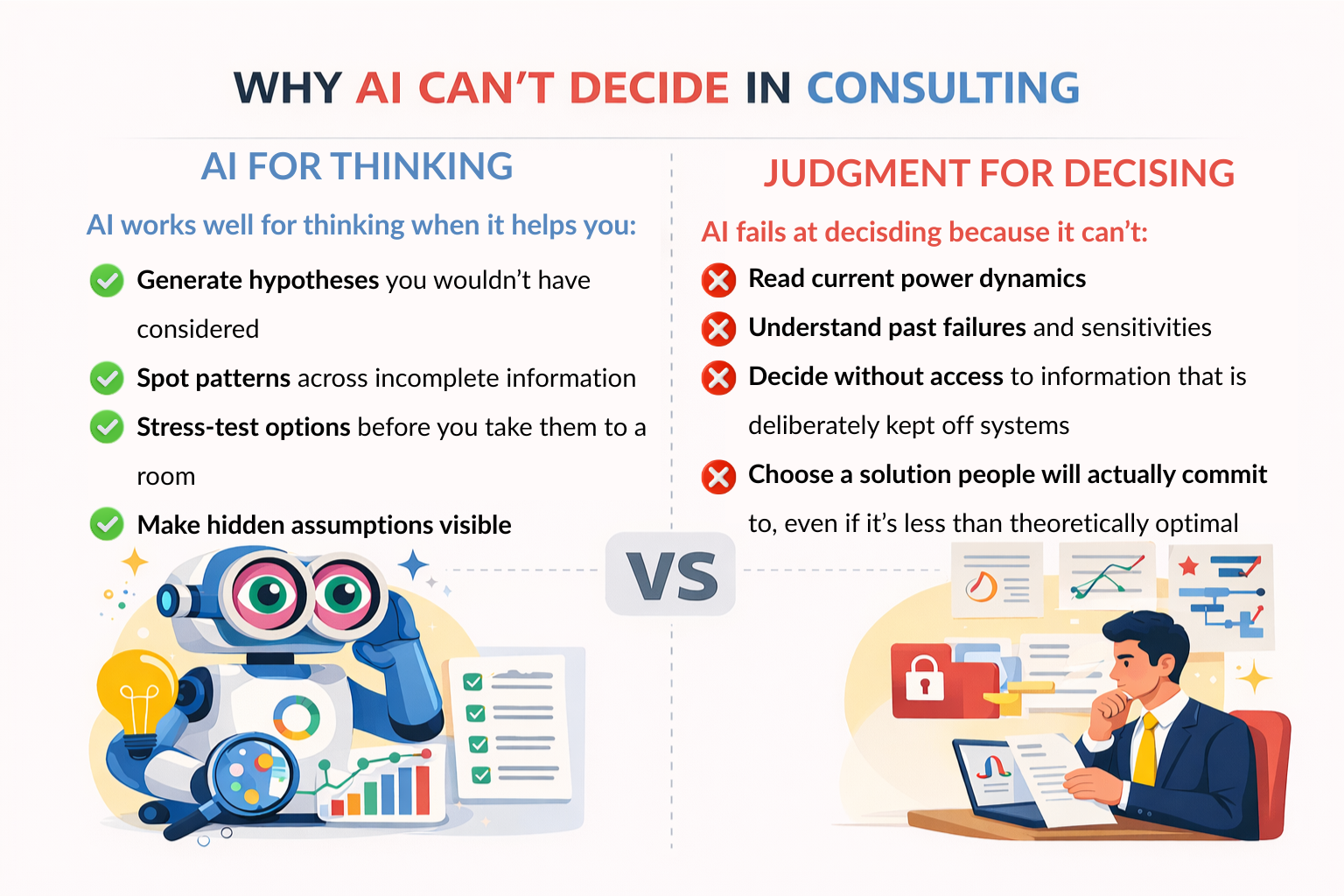
AI works well for thinking when it helps you:
- Generate hypotheses you wouldn’t have considered
- Spot patterns across incomplete information
- Stress-test options before you take them to a room
- Make hidden assumptions visible
AI fails at deciding because it cannot:
- Read current power dynamics
- Understand past failures and sensitivities
- Decide without access to information that is deliberately kept off systems
- Choose a solution people will actually commit to, even if it’s less than theoretically optimal
In 2025, the consultants who got real value from AI didn’t try to automate decisions. They used AI to brutally widen the option space, then applied judgment to aggressively narrow it.
That narrowing step didn’t disappear. It became the job.
This is the lens I’ll use in a short 2026 series on how I personally use AI in consulting, grounded in real constraints, not demos.
If you’re experimenting with AI this week, try this:
Use AI to expand options. Then deliberately kill most of them yourself.
That’s where consulting value still lives.